What Your Eyes Cannot See
Stand beside a waterfall and you see individual droplets, crashing spray, turbulent chaos. Open your shutter for two seconds and that chaos transforms into silk. Stand on a cliff above the ocean and you see waves surging and retreating. Open your shutter for thirty seconds and that ocean becomes a mirror of mist. Stand in a field under a clear sky and you see motionless stars. Open your shutter for an hour and those stars carve luminous arcs across the heavens.
Long exposure photography reveals a version of the world that exists but that your eyes, locked at roughly 1/30 of a second, can never perceive. It is one of the few photographic techniques that does not attempt to replicate what you see. It creates something new.
But getting there requires technical precision. Shutter speeds, filter strengths, exposure calculations, and equipment choices all matter. Get one variable wrong and you end up with a blown-out mess or a noisy underexposed frame. This guide gives you the complete technical foundation so you can focus on what actually matters: the creative decisions.
Essential Gear for Long Exposure
ND Filters: Your Light Control System
Neutral Density filters reduce the amount of light entering your lens without altering color. They are the single most important piece of gear for daytime long exposure work. Without them, your camera cannot achieve multi-second exposures in anything brighter than deep twilight.
The terminology around ND filters is needlessly confusing. Different manufacturers use different naming conventions. Here is the reference chart that clarifies everything:
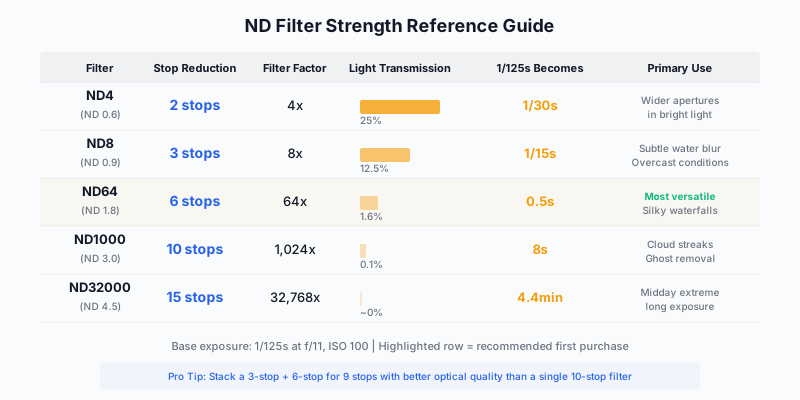
The first filter you should buy is a 6-stop (ND64). It is the most versatile option: strong enough to create silky water effects in most daylight conditions, but not so extreme that it introduces the color cast problems common with 10-stop filters.
The Case Against the 10-Stop Filter
The 10-stop ND is the most popular long exposure filter sold. It is also, for many photographers, the wrong choice.
Here is why: most 10-stop filters, including those from reputable brands, introduce a noticeable color cast, typically a warm magenta or cool blue shift. This cast must be corrected in post-processing, and the correction process can reduce color accuracy and tonal smoothness. Additionally, the viewfinder goes essentially black through a 10-stop filter, making composition impossible after mounting it.
Many working professionals prefer stacking a 3-stop and 6-stop filter for 9 stops of total reduction. The optical quality of each individual filter is higher, and you retain the ability to use either filter independently. Bryan Peterson recommends this stacking approach in Understanding Exposure for precisely this reason: it gives you three filters (3-stop, 6-stop, 9-stop combined) for the price of two.
The Rest of the Kit
Tripod: This is not the place to cut corners. Wind is the enemy of long exposure photography, and a lightweight travel tripod will vibrate in any breeze. Look for a tripod rated to at least twice the weight of your heaviest camera-lens combination. Carbon fiber dampens vibration better than aluminum.
Remote release or intervalometer: Any contact with the camera during exposure creates blur. A cable release, wireless remote, or your camera’s built-in timer eliminates this. For star trail stacking, an intervalometer is essential.
Lens hood: ND filters add another glass surface in front of your lens. Without a hood, stray light hitting that surface creates flare and reduces contrast.
Camera Settings: The Foundation
The Base Configuration
Every long exposure starts from the same foundation:
- ISO 100 (or your camera’s native base ISO, which is ISO 64 on Nikon Z bodies)
- Aperture f/8 to f/11: The sharpness sweet spot for most lenses. Avoid f/16 and smaller, where diffraction softens the image.
- Manual focus: Set focus before mounting the ND filter, then switch to manual focus to lock it.
- Mirror lockup or electronic first curtain shutter: Eliminates mirror slap vibration on DSLRs; reduces shutter shock on mirrorless.
- Long exposure noise reduction: Enable this for exposures over 30 seconds. It doubles your capture time by taking a dark frame, but it significantly reduces hot pixels.
Calculating Exposure with ND Filters
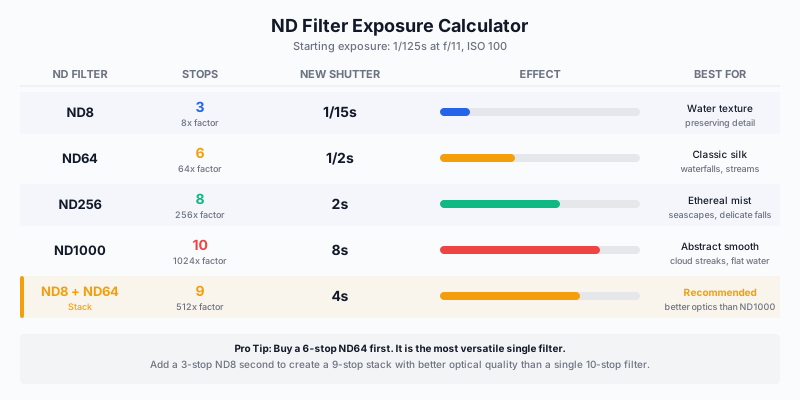
The calculation is straightforward once you understand it. Take a correctly exposed reading without the filter, then multiply the shutter speed by the filter factor.
Example: Without filter at f/11, ISO 100: correct exposure is 1/125 second.
With a 6-stop ND (filter factor 64x):
1/125 x 64 = 64/125 = approximately 1/2 second
With a 10-stop ND (filter factor 1024x):
1/125 x 1024 = 1024/125 = approximately 8 seconds
Or count stops the old-fashioned way:
| Starting |
+1 stop |
+2 stops |
+3 stops |
+4 stops |
+5 stops |
+6 stops |
| 1/125 |
1/60 |
1/30 |
1/15 |
1/8 |
1/4 |
1/2 |
The PhotoPills app includes an ND filter exposure calculator that handles this instantly in the field.
Waterfall Photography: The Signature Long Exposure Subject
Waterfalls are where most photographers first encounter long exposure technique, and for good reason. The transformation from chaotic water to flowing silk is dramatic and immediately rewarding.
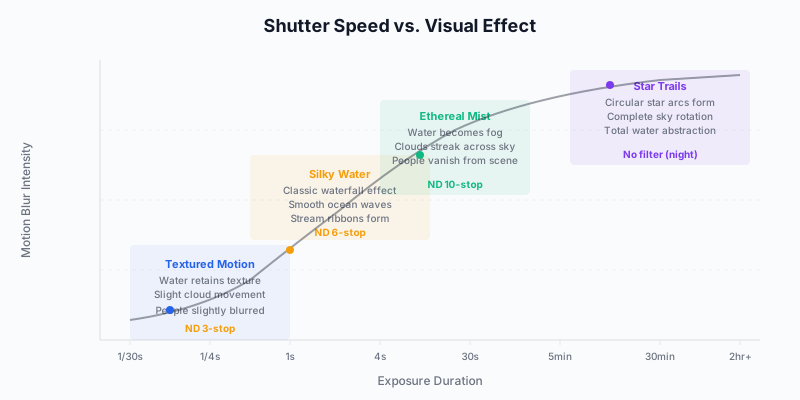
But not all waterfall exposures are equal. The shutter speed you choose determines the character of the water, and the right choice depends on the specific waterfall, its flow rate, and the mood you want to create.
Shutter Speed vs. Water Character
| Shutter Speed |
Water Effect |
Best For |
| 1/15 to 1/4 sec |
Motion visible, texture preserved |
Powerful waterfalls where you want to convey force |
| 1/2 to 2 sec |
Classic silk effect |
The standard waterfall look, clean and elegant |
| 4 to 15 sec |
Ethereal mist |
Delicate cascades, thin streams, dreamy mood |
| 30 to 120 sec |
Complete abstraction |
Artistic interpretations, ghost-like veils |
The mistake most beginners make is going straight to multi-second exposures for every waterfall. A 1/8 second exposure of a thundering waterfall preserves the raw power of the falling water while adding just enough motion blur to separate it from a frozen snapshot. Reserve longer exposures for smaller, more delicate falls where the mist effect enhances rather than eliminates the character of the water.
The Two-Shot Blend Technique
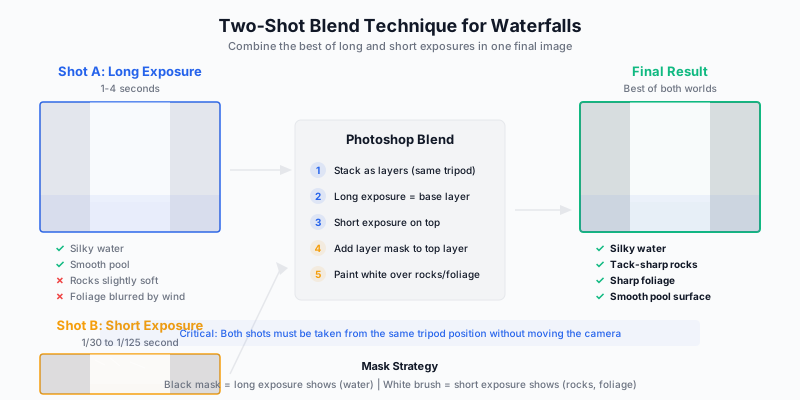
Professional waterfall photographers rarely settle for a single exposure. Instead, they capture two frames:
- Long exposure (1-4 seconds): Silky water, smooth foreground pool
- Short exposure (1/30 to 1/125): Sharp surrounding rocks, moss, and foliage
Blend these in Photoshop using a simple luminosity mask or manual brush on a layer mask. The result gives you silky water with tack-sharp surroundings, something no single exposure can achieve because long exposures subtly soften everything, not just the water.
Waterfall Composition Principles
- Include the entire fall plus the splash pool: The pool reflection and churning water at the base add foreground interest.
- Find an elevated angle: Shooting slightly downward reveals more of the cascade and prevents the sky from dominating.
- Use surrounding vegetation as framing: Overhanging branches and mossy rocks create natural frames.
- Shoot in overcast conditions: Direct sunlight on a waterfall creates extreme dynamic range that exceeds your sensor’s capability. Overcast light is even, shadowless, and saturates colors in the surrounding foliage.
Seascape Long Exposure
Coastal long exposure photography is technically more demanding than waterfall work because you are dealing with a dynamic, unpredictable subject. Waves do not repeat identically. Tides change the scene continuously. Wind affects your tripod stability.
Reading the Water Before You Shoot
Spend at least ten minutes observing the ocean before you mount your camera on a tripod. Note:
- Wave interval timing: How many seconds between wave sets? This determines your exposure timing.
- Receding water patterns: Where does water drain off rocks? These drain lines create leading lines in long exposures.
- Foam accumulation: Where does sea foam collect? Foam streaks become sweeping compositional elements in longer exposures.
- Tide direction: Is the tide coming in or going out? This changes which rocks and features are accessible.
Shutter Speed Selection for Seascapes
| Shutter Speed |
Effect |
Mood |
| 0.5 to 2 sec |
Dynamic motion preserved, wave texture visible |
Energetic, powerful |
| 5 to 15 sec |
Ethereal mist around rocks, waves smooth |
Contemplative, moody |
| 30 to 120 sec |
Mirror-calm water, cloud streaks |
Minimalist, serene |
| 3 to 10 min |
Water becomes perfectly flat, clouds become dramatic streaks |
Abstract, otherworldly |
Timing the Shutter Release
For exposures under 5 seconds, timing matters. Start your exposure just as a wave begins to recede from the rocks. The retreating water creates sweeping lines that radiate outward from the foreground. If you start during the wave’s approach, you get chaotic foam with no directional flow.
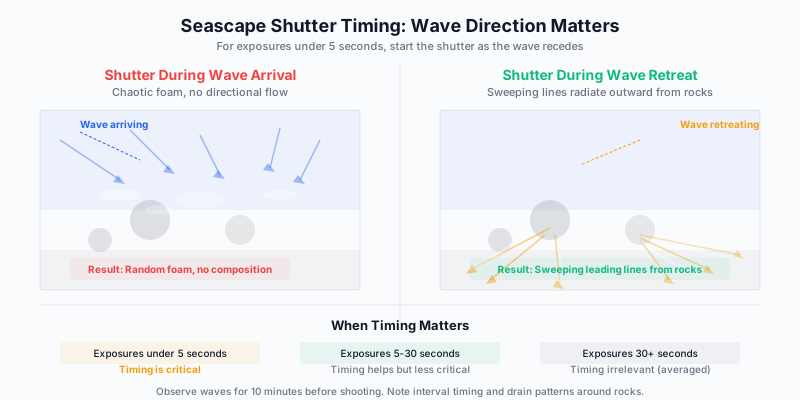
For exposures over 30 seconds, timing becomes irrelevant. Multiple wave cycles average out into a uniform mist regardless of when you begin.
Star Trail Photography
Star trails occupy the extreme end of long exposure work. Exposure times range from 20 minutes to several hours, and the techniques split into two fundamentally different approaches.
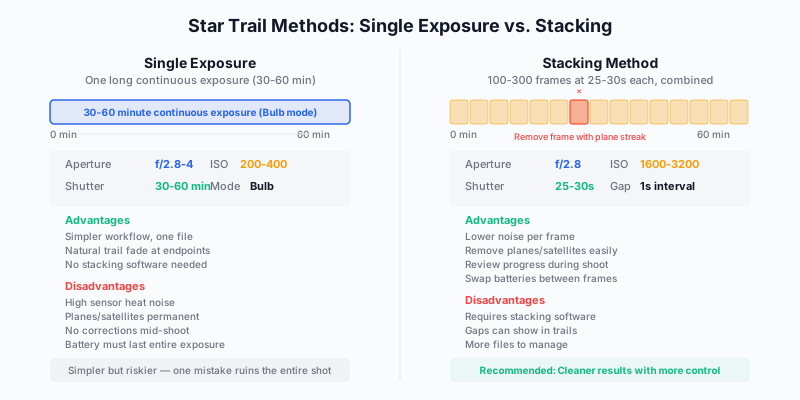
Single Exposure Method
- Shutter speed: 30 to 60 minutes (Bulb mode)
- Aperture: f/2.8 to f/4
- ISO: 200 to 400
- Focus: Manual, set on a bright star using Live View at maximum magnification
Advantages: Simpler workflow, natural light falloff at trail ends. Disadvantages: Higher noise from sensor heat during long exposure, planes and satellites create unremovable streaks, no mid-shoot corrections possible.
Stacking Method (Recommended)
Capture 100 to 300 individual frames at 25 to 30 seconds each, then combine them in stacking software like StarStax (free) or Photoshop.
Settings per frame:
- Shutter: 25 to 30 seconds
- Aperture: f/2.8
- ISO: 1600 to 3200
- Interval: 1 second gap between frames (set on intervalometer)
Advantages: Lower noise per frame, planes and satellites easily removed by excluding individual frames, you can review progress during the shoot, battery replacement possible between frames.
The stacking method produces cleaner results with more control. It is the approach used by essentially all professional astrophotographers for star trail work.
Finding Polaris for Circular Trails
In the Northern Hemisphere, stars appear to rotate around Polaris (the North Star). Composing with Polaris near the center of your frame creates concentric circular trails. Composing with Polaris off to one side creates sweeping arcs. The choice is aesthetic: circles feel symmetrical and meditative; arcs feel dynamic and directional.
In the Southern Hemisphere, use Sigma Octantis (the South Celestial Pole) as your rotation center, though it is much fainter than Polaris.
Post-Processing Long Exposures
Correcting ND Filter Color Cast
Shoot RAW. Always. ND filter color casts are easily corrected in post if you have RAW data, and nearly impossible to fix cleanly from JPEG. In Lightroom, use the eyedropper white balance tool on a neutral gray element in the scene (a rock, a concrete surface). If no neutral reference exists, adjust temperature and tint manually until colors appear natural.
Dealing with Hot Pixels
Long exposures heat the sensor, causing individual pixels to glow bright red, green, or blue. These are hot pixels, and they increase with exposure duration and ambient temperature.
Solutions:
- In-camera LENR (Long Exposure Noise Reduction): Takes a dark frame of equal duration and subtracts hot pixel pattern. Effective but doubles your shooting time.
- Lightroom Spot Removal: Manual removal of individual hot pixels. Tedious for exposures with hundreds.
- Dedicated software: Topaz DeNoise or DxO PureRAW handle hot pixel removal automatically while preserving detail.
Maintaining Sharpness
Soft images in long exposure work usually result from one of three causes:
- Tripod vibration from wind: Weigh down your tripod’s center column, shorten the legs, and avoid extending the center column.
- Filter-induced softness: Lower-quality ND filters degrade optical sharpness. Invest in quality glass from manufacturers like NiSi, Lee, or Breakthrough Photography.
- Diffraction from small apertures: f/16 and f/22 reduce sharpness through diffraction. Stay at f/8 to f/11 and use stronger ND filters instead of stopping down further.
Exercises for Building Long Exposure Skill
Exercise 1: The Shutter Speed Bracket
At a waterfall, shoot the identical composition at 1/15, 1/4, 1, 4, and 15 seconds. Review all five images at home and identify which shutter speed produces the water effect that best matches the character of that specific waterfall. You will discover that there is no universally correct shutter speed; the right choice depends on flow rate, drop height, and water volume.
Exercise 2: The Filter Stack Test
Shoot the same scene with a single 10-stop filter, then with a 3-stop plus 6-stop stack (9 stops combined). Compare the images at 100% zoom for sharpness, color accuracy, and edge detail. This test reveals whether your specific filters suffer from stacking degradation and whether a single strong filter or stacked combination works better with your equipment.
Exercise 3: The Seascape Timing Drill
At a rocky coastline, shoot twenty 2-second exposures. For ten of them, start the exposure as a wave arrives. For the other ten, start as a wave recedes. Compare the wave patterns in each set. This exercise trains your timing instincts for coastal long exposure work.
Exercise 4: Your First Star Trail Stack
On a clear, moonless night, set up your camera pointed at Polaris, set your intervalometer for 30-second exposures with 1-second gaps, and capture 120 frames (one hour total). Stack them in StarStax using the Lighten blending mode. This exercise teaches the stacking workflow and gives you a finished star trail image that would be extremely difficult to achieve with a single exposure.
Conclusion
Long exposure photography demands more technical precision than almost any other discipline. You must understand filters, calculate exposures, manage equipment vibration, and accept that each frame takes minutes rather than fractions of a second. The learning curve is real.
But the reward is equally real. Long exposure reveals a dimension of the world that exists beyond human perception. Water becomes silk. Clouds become brushstrokes. Stars become rivers of light. Master the technical foundation laid out in this guide, then go to the water’s edge, mount your filter, and open the shutter. What you see on your LCD will be something no human eye has ever witnessed in quite that way before.