The Composition Trap Most Photographers Never Escape
You learned the rule of thirds in your first week of photography. You placed your horizon on the upper line, positioned your subject at an intersection point, and your images improved overnight. That was three years ago. Your compositions still look the same.
Here is the uncomfortable truth: the rule of thirds is a simplification of deeper mathematical principles that artists have used for centuries. It works because it approximates the golden ratio, not because dividing a frame into equal sections is inherently powerful. The photographers whose work hangs in galleries and wins international competitions draw from a richer compositional vocabulary, one that includes the phi grid, the golden spiral, dynamic symmetry, and frameworks that adapt to the specific geometry of each scene.
This guide breaks down those frameworks with the clarity and specificity you need to actually apply them in the field. Not theory for theory’s sake, but practical tools that change the way you see and frame the world.
The Phi Grid: Why 1.618 Beats Equal Thirds
The phi grid looks nearly identical to the rule of thirds at first glance. Both overlay two horizontal and two vertical lines on your frame. The difference is in the spacing.
The rule of thirds divides the frame into three equal sections: 33.3% each. The phi grid uses the golden ratio (1.618:1) to create sections of approximately 38.2%, 23.6%, and 38.2%. The result is that the intersection points sit slightly closer to the center of the frame.
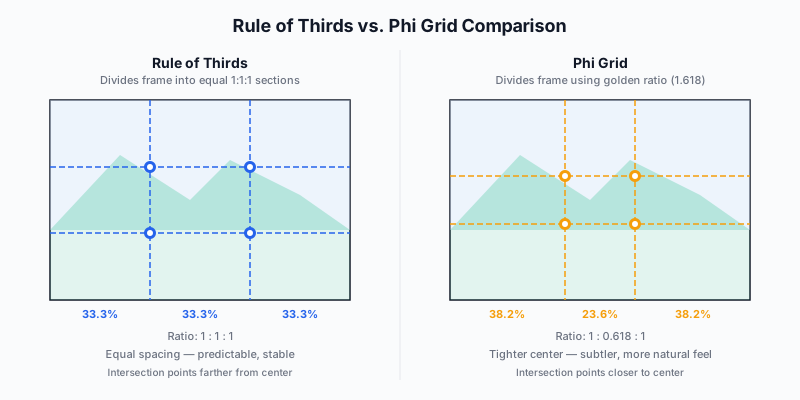
This difference matters more than you might expect. When you place a subject on a phi grid intersection, it occupies a position that feels balanced without feeling formulaic. The subject commands attention without being shoved to the edge of the frame, and the surrounding negative space feels more naturally distributed.
Michael Freeman discusses this extensively in The Photographer’s Eye, noting that the golden ratio appears so frequently in nature and classical art that our visual processing system has evolved to find it inherently pleasing. Whether that is cultural conditioning or biological wiring is debated, but the practical effect is undeniable.
The phi grid excels in specific scenarios:
- Single dominant subject in an open landscape: A lone tree, a distant mountain peak, a lighthouse on a headland. The phi grid gives these subjects breathing room without isolating them.
- Horizon placement in seascapes: Position your horizon on the phi line rather than the third line. The difference is subtle but it removes the “textbook” quality that marks a rule-of-thirds composition.
- Portrait-oriented landscapes: In vertical compositions, the tighter center column of the phi grid prevents the awkward left-right imbalance that equal thirds can create.
- Gallery prints and fine art work: When a viewer stands in front of a large print for extended contemplation, phi grid compositions hold attention longer than thirds-based work.
When to Stick with Thirds
The rule of thirds still earns its place for fast-moving situations where you need a reliable compositional framework without deliberation. Street photography, sports, wildlife action, photojournalism: anywhere that speed trumps refinement, thirds works.
The Golden Spiral: Nature’s Compositional Blueprint
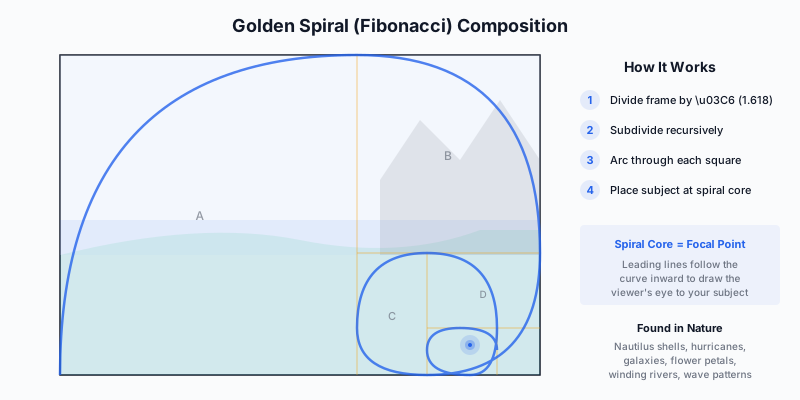
The golden spiral emerges when you recursively subdivide a golden rectangle and connect the corners of each resulting square with a quarter-circle arc. The resulting curve appears throughout the natural world in nautilus shells, hurricane formations, galaxy arms, sunflower seed heads, and the unfurling of fern fronds.
For photographers, the golden spiral serves as a compositional flow path. You position secondary elements along the curve and your primary subject at the spiral’s convergence point, the tight core where the viewer’s eye naturally comes to rest.
Recognizing Spiral Compositions in the Wild
The golden spiral is not something you overlay on every scene. It is a pattern you learn to recognize when it already exists in the landscape before you.
Look for these natural spiral indicators:
- Winding rivers and coastlines: A river that sweeps from the upper corner of your frame toward a foreground element follows the spiral path.
- Cloud formations: Cyclonic weather patterns, lenticular clouds, and swirling mist create spiral shapes visible from both ground and aerial perspectives.
- Mountain ridgelines: A series of ridges descending from a peak toward the viewer can trace a spiral arc.
- Wave patterns: Receding surf on a curved beach creates natural spiral-like flow.
- Aerial views of deltas and braided rivers: From a drone, water systems reveal spiral geometry invisible from ground level.
Orienting the Spiral
The spiral can be flipped and rotated into eight orientations (four corners, each mirrored). The key principle: the spiral’s core should sit on or near your primary subject, and the expanding arc should follow the direction of natural flow in the scene. If a river enters from the top-left and curves toward a cabin in the lower-right, orient the spiral to match that flow.
Galen Rowell, one of the greatest landscape photographers in history, composed many of his iconic images from Mountain Light along spiral paths, even if he described the process intuitively rather than mathematically. His famous “Rainbow Over the Potala Palace” places the palace at the spiral core with the rainbow arcing through the expanding curve.
The Golden Triangle: Embracing Diagonals
Not every scene presents horizontal and vertical divisions. Mountain slopes, roads cutting through valleys, diagonal shadows, and slanting light all create scenes dominated by diagonal energy. Forcing a horizontal-vertical grid onto these compositions creates tension that feels wrong.
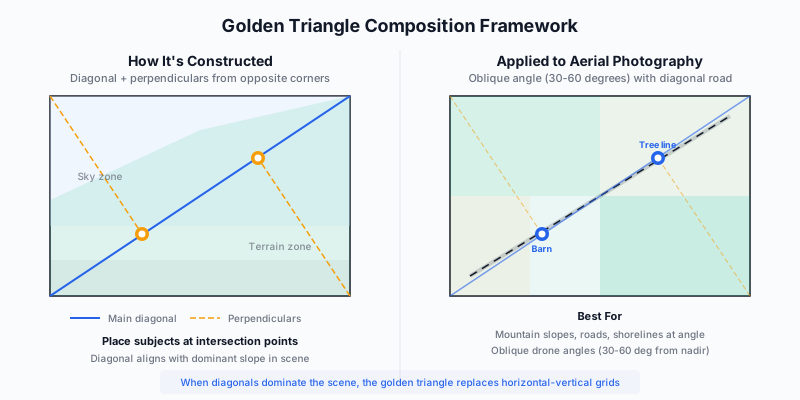
The golden triangle divides the frame with a diagonal line from corner to corner, then drops perpendicular lines from the remaining corners to that diagonal. This creates triangular zones that harmonize with diagonal elements in the scene.
Application in Landscape Photography
- Mountain slopes: Align the dominant ridgeline with the main diagonal. Place your subject (a hiker, a cabin, a tree) at the intersection of the perpendicular lines.
- Roads and paths: A road cutting diagonally through the frame follows the main diagonal, with the vanishing point at one of the triangle intersections.
- Shorelines at angle: A beach photographed at an angle, rather than parallel to the water, naturally divides the frame into triangles.
Application in Aerial Photography
From altitude, diagonal lines become even more prominent. Roads, field boundaries, rivers, and shadows create powerful diagonal structures. The golden triangle gives you a framework to harness that diagonal energy rather than fighting it.
When flying at an oblique angle (30-60 degrees from nadir), nearly every scene presents diagonal compositions. The golden triangle becomes your primary tool at these angles.
Dynamic Symmetry: The Framework Professionals Use
Dynamic symmetry, developed by Jay Hambidge in the early twentieth century and applied extensively in classical painting, uses the diagonal of a rectangle and its reciprocal to create a grid of intersecting lines. The result is a network of compositional anchors that adapt to the specific aspect ratio of your frame.
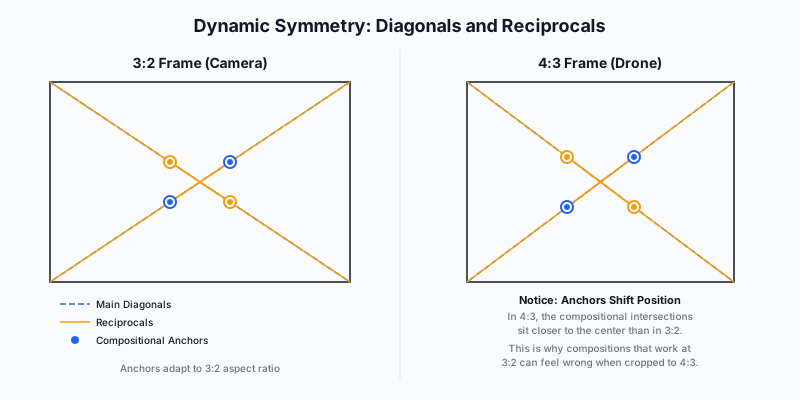
Unlike the phi grid or rule of thirds, dynamic symmetry considers the frame as a unified geometric system rather than a simple subdivision. The “sinister” diagonal (corner to corner) and “baroque” diagonal (the reciprocal) create intersections that feel locked into the geometry of the specific image.
Why This Matters for Different Aspect Ratios
Most photographers ignore the fact that a 3:2 frame, a 4:3 frame, a 16:9 frame, and a 1:1 frame each have fundamentally different compositional geometry. A rule-of-thirds intersection sits at the same proportional position regardless of aspect ratio, which is why a composition that works at 3:2 can feel wrong when cropped to 16:9.
Dynamic symmetry generates different grids for different ratios. This is why it matters for aerial photographers who may shoot 4:3 on a drone and 3:2 on a mirrorless body: the compositional framework must adapt to the frame.
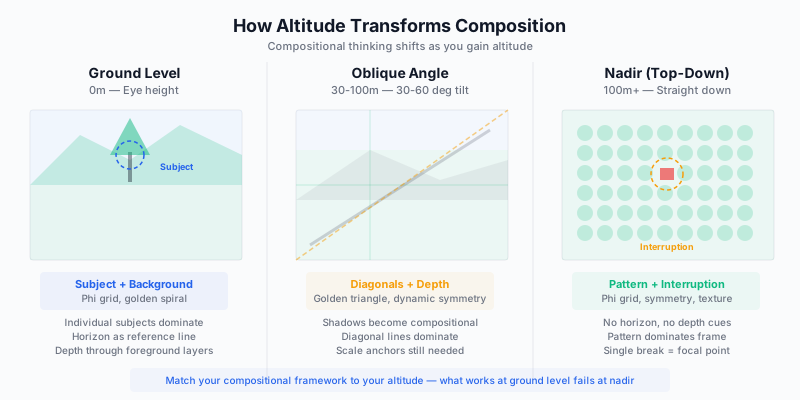
Aerial photography does not simply give you a higher perspective. It fundamentally changes what composition means.
Patterns Replace Subjects
At ground level, you compose around subjects: a mountain, a tree, a person. At 100 meters and above, individual subjects dissolve into patterns. Agricultural fields become geometric mosaics. Forests become textural canopies. Cities become circuit boards. Your compositional thinking must shift from “subject and background” to “pattern and interruption.”
The interruption is the key. A single red barn in a green field. A winding river cutting through a grid of farmland. A shadow that breaks a repeating texture. Dirk Dallas, author of Eyes over the World, emphasizes that the strongest aerial compositions find the single element that disrupts an otherwise uniform pattern.
Scale Anchors Become Essential
Without familiar reference points, viewers cannot process the scale of an aerial image. A photograph of sand dunes from 200 meters looks identical to a macro photograph of wrinkled fabric. Including a road, a vehicle, a person, or a building gives the viewer the cognitive anchor they need to understand they are looking at a landscape, not an abstraction.
Shadows Become Subjects
From directly above, shadows cast by trees, buildings, and mountains become compositional elements as powerful as the objects casting them. In low-angle light (early morning, late afternoon), shadows can dominate the frame. Compose for the shadow pattern, not just the physical objects.
The Nadir vs. Oblique Decision
Straight-down (nadir) compositions eliminate horizon lines entirely, creating abstract, pattern-focused images. Oblique angles (30-60 degrees) reintroduce horizon and depth, creating images that feel more like elevated landscape photography. Your compositional framework should match your angle: dynamic symmetry and triangles work best at oblique angles; phi grids and pattern-based thinking work best at nadir.
Compositional Layering: The Professional’s Secret
Advanced compositions rarely rely on a single framework. Professionals layer multiple compositional elements:
- Primary structure: The dominant grid or spiral that places the main subject.
- Leading lines: Secondary elements that guide the eye toward the subject.
- Framing elements: Foreground objects that create a frame-within-a-frame.
- Tonal weight distribution: Balancing bright and dark areas across the frame.
- Color relationships: Using complementary or analogous color placement to reinforce the composition.
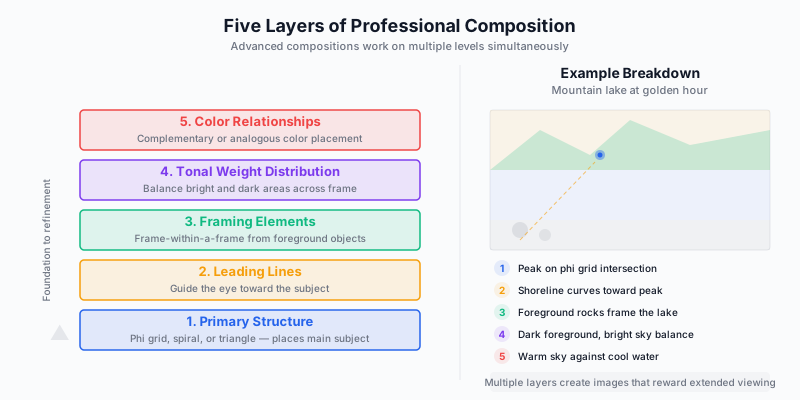
Bruce Barnbaum, in The Art of Photography, argues that great compositions work on multiple levels simultaneously: the geometric structure provides the foundation, while tonal and color relationships provide the emotional resonance.
Exercises for Developing Compositional Mastery
Exercise 1: Grid Overlay Analysis
Download 20 images from photographers you admire. In Lightroom or Photoshop, overlay both the rule-of-thirds grid and the phi grid on each image. Note which framework the photographer instinctively used, and which intersections their subject occupies. You will find that most accomplished photographers naturally gravitate toward phi grid placement even if they have never heard the term.
Exercise 2: Spiral Scouting Walk
Before your next shoot, walk your location with your camera lowered. Look only for spiral patterns: curving paths, winding waterways, circular rock formations, spiraling trees. When you find one, compose an image that places the spiral’s convergence point on your primary subject. Shoot ten spiral compositions in a single session.
Exercise 3: Altitude Variation Series
Photograph the same subject from ground level, then from 30 meters, 100 meters, and maximum legal altitude with a drone. At each altitude, apply the compositional framework that best suits the perspective: phi grid at ground level, golden triangle at oblique drone angles, pattern-based thinking at nadir. Study how composition must adapt to altitude.
Take a strong 3:2 composition and crop it to 4:3, 16:9, and 1:1. For each crop, re-evaluate which compositional grid applies. Notice how a subject that sat on a phi grid intersection at 3:2 may need repositioning at 16:9. This exercise builds awareness of how aspect ratio shapes composition.
Exercise 5: Deliberate Rule Breaking
Once you have internalized these frameworks, break them intentionally. Center your subject. Place the horizon dead in the middle. Position your focal point in a corner. Document why each break works or fails. The goal is not to abandon the rules but to understand them deeply enough to know when breaking them creates stronger images.
Conclusion
The rule of thirds is training wheels. The phi grid, golden spiral, golden triangle, and dynamic symmetry are the tools of a compositional craftsman. They do not replace artistic intuition; they refine it. They give you a vocabulary for the decisions you already make subconsciously and a framework for the decisions you have not yet learned to make.
Master these techniques through deliberate practice, and your compositions will possess the quality that separates images people glance at from images people stand in front of and study. That quality is not magic. It is mathematics, perception, and ten thousand conscious decisions that eventually become instinct.